| Artist |
Sargent, John Singer |
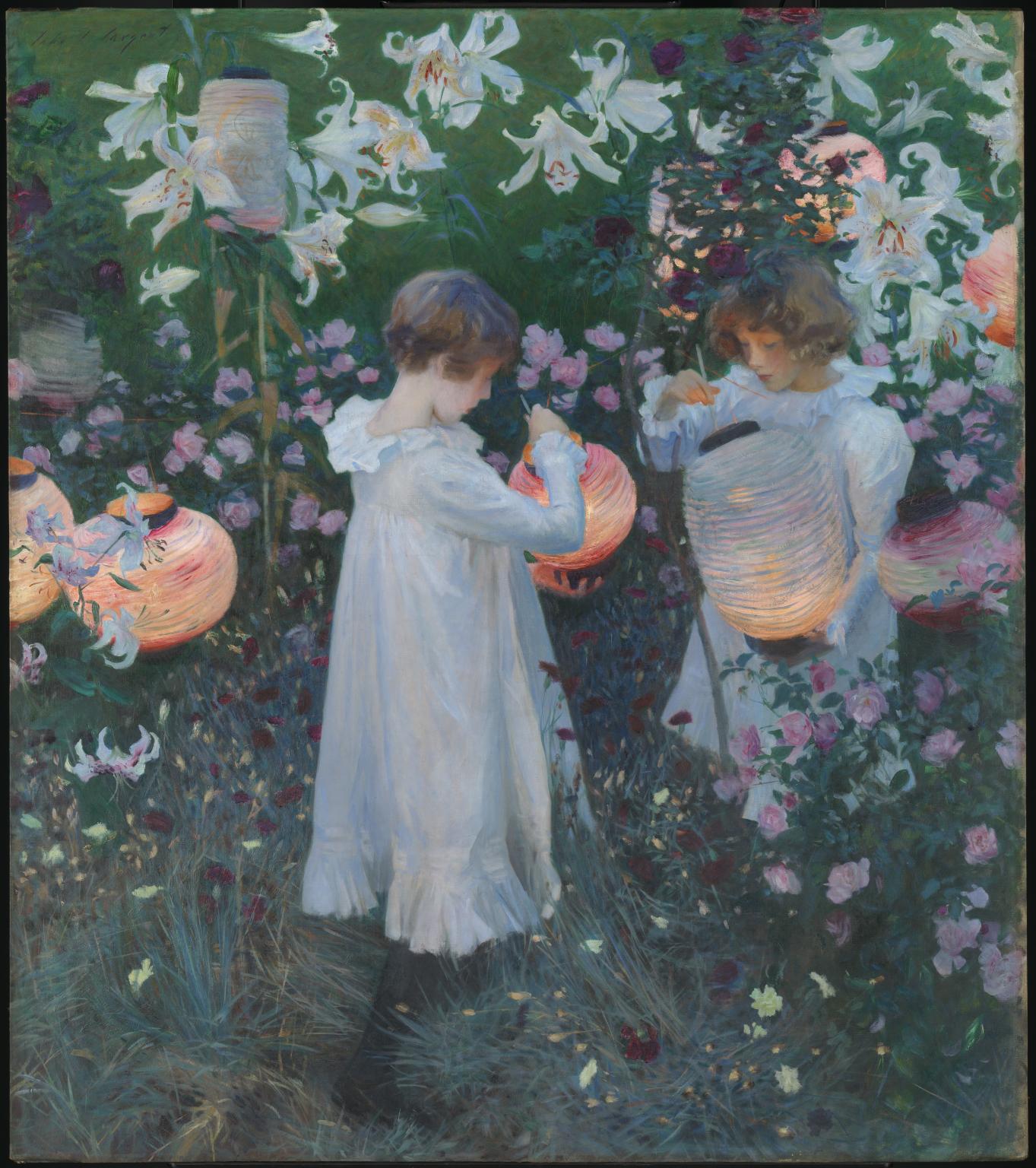
The inspiration for Carnation, Lily, Lily, Rose came from a moment observed in August 1885 at Pangbourne in Berkshire, where Sargent was boating with the American artist Edwin Austin Abbey. Sargent described it some weeks later: ‘I am trying to paint a charming thing I saw the other evening. Two little girls in a garden at twilight lighting paper lanterns among the flowers from rose-tree to rose-tree. I shall be a long time about it if I don’t give up in despair’ (letter to Edwin Russell, 10 September 1885; Tate Gallery Archives). This fleeting impression became the subject of his English nocturne, an outdoor study that preoccupied and taxed him throughout the late summer and autumn of 1885 and 1886.
It began as a single-figure composition with Kate, the five-year-old daughter of Frank and Lily Millet, as the model. She was replaced by the children of the illustrator Frederick Barnard, Polly and Dolly, who were older (eleven and seven), picturesquely fair-haired and who posed in specially made white dresses. There was a considerable process of development and refinement: a sequence of pencil studies in a sketchbook (Fogg Art Museum, Cambridge, Mass., 1937.7.21 5r, 6v, 10v, 11r, 12v) records Sargent working through differences of viewpoint and variations in the disposition of the figures and includes a detailed sketch of lilies; these drawings also chart the way the composition moves from a single figure in a spacious setting to a tight, densely decorative two-figure work. Oil studies also indicate experimentation with the figures: one study shows the girls with their backs to each other (Private Collection) and an X-ray of a portrait of their mother, Mrs Frederick Barnard (Private Collection), painted at around the same time, shows beneath the portrait a sketch of a single girl with lanterns, roses and lilies. There are two further oil studies of Dolly and one of Polly (Private Collections), and beautifully rendered presentation sketches of their faces in pencil (Tate Gallery). Preparatory works also suggest that the composition was rectangular until a relatively advanced stage; Abbey described it as ‘seven feet by five’ (letter to Charles Parsons of 28 September 1885, Lucas 1921, vol. 1, p. 150) and, in an undated letter to his sister Emily, Sargent drew a rough pen-and-ink sketch with the figures in close relationship to those in the finished work, but still framed as a distinct rectangle (facsimile of letter repr. Charteris 1927, pp. 76–7). After he had worked out the position of the figures, Sargent extended the composition at the top and reduced it at the side so that the finished canvas is almost square. In this compressed pictorial space, the figures are clearly the focal point but Sargent lays out a flat and stylised arrangement of flower patterns around them creating an aesthetic, decorative design.
The project was beset by practical and technical difficulties. In the letter to Emily already quoted, Sargent wrote: ‘I am launched into my garden picture and have two good little models and a garden that answers the purpose although there are hardly any flowers and I have to scour the cottage gardens and transplant and make shift ... Fearful difficult subject. Impossible brilliant colours of flowers and lamps and brightest green lawn background. Paints are not bright enough, and then the effects only last ten minutes.’ He was aiming faithfully to transcribe complex natural and artificial light effects, the cool waning light of early evening and warm candlelight illuminating the lanterns and reflected off the girls’ faces, their white dresses and the lily petals. Working with a lyrical palette of white, grey, blue, mauve and pink, he used subtle tonal phrasing to create a poetic image: seen through a veil of blue-grey shadows, the tangled grasses take on a mysterious quality, and detail is elided, so that the lanterns and lilies, their means of support barely visible, seem to float in an ethereal dusk.
He was hampered by the fact that he had started work on the picture towards the end of the flowering season. He catalogued his difficulties to Robert Louis Stevenson, whom he had recently visited and painted in Bournemouth (see fig. 31): ‘“Carnation lily lily rose”, has brought me to bed of a picture, O God, most ugly just now. I saw a most paradisiac sight at the end of September [sic] instead of in June as I should have done ... Now my garden is a morass, my rose trees black weeds with flowers tied on from a friend’s hat and ulsters protruding from under my children’s white pinafores. I wish I could do it! With the right lighting and the right season it is a most extraordinary sight and makes one rave with pleasure, and the theme in the abstract is charming’ (undated letter, Stevenson Papers, Beinecke Library, Yale University, 5427). Sargent left Broadway towards the end of 1885 with the picture incomplete, but the frustrations of the autumn had left him forewarned and the following spring he sent down Auratum lily bulbs for Lucia Millet to put into pots in readiness. Fate intervened in the shape of an injury to Frederick Barnard’s leg, delaying the visit of Sargent’s young models to Broadway, but they arrived eventually and the picture was virtually finished by early October.
Edmund Gosse has left a memorable description of Sargent at work on the picture, recording how ‘each evening he took up his place at a distance from the canvas, and at a certain notation of the light ran forward over the lawn with the action of a wag-tail, planting at the same time rapid dabs of paint on the picture, and then retiring again, only with equal suddenness, to repeat the wag-tail action’ (Charteris 1927, pp. 74–5). For all this cavalier manner and apparent verve of execution, there can be no doubt that the painting was the product of sustained, disciplined effort. Blashfield records that each morning the canvas was ‘scraped down to the quick’. This happened for many days, then the picture, daughter of repeated observation and reflection, suddenly came to stay (Blashfield 1925, p. 644).
The literary title, from a popular song ‘The Wreath’ by Joseph Mazzinghi, invites association with a narrative tradition, as well as with a genre of English garden paintings, flower symbolism and themes of childhood innocence. Sargent is navigating between aspects of Impressionism – a concern with the depiction of light, with plein-air painting and inflected brushwork – which would have seemed radical to an English audience at the time, and more accessible, established traditions. The painting was a popular and critical success when it was exhibited at the Royal Academy in 1887 and its immediate acquisition for the nation under the terms of the bequest of the sculptor Sir Francis Chantrey (which established a fund to purchase works made in England), was a remarkable accolade for a young, foreign painter.
INSCRIPTIONS ‘John S. Sargent’ t.l.
ACCESSION NUMBER
N01615
|